Sleep Is Part of Physical Therapy Recovery
This post was reviewed and updated on .
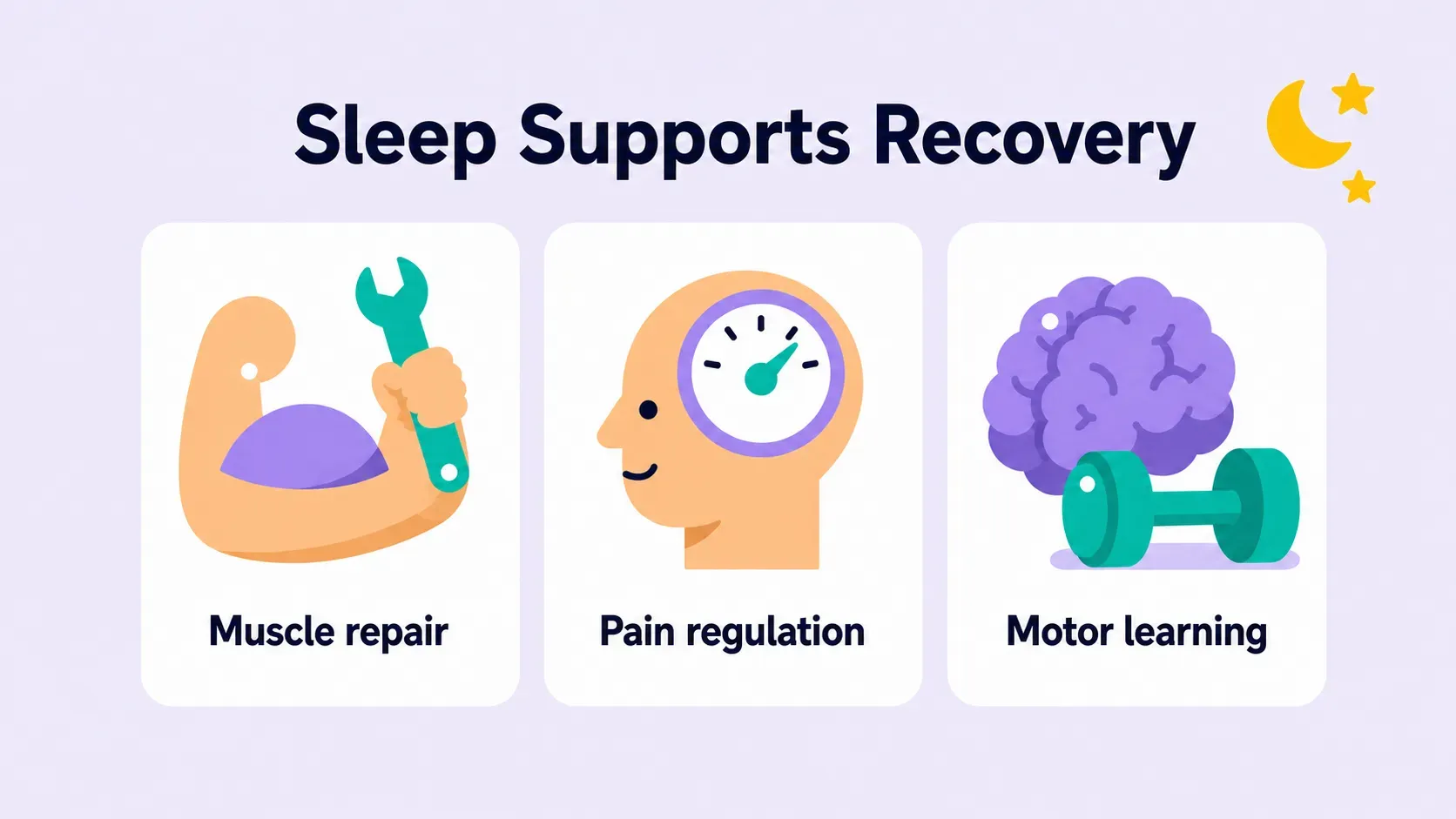
Sleep is not downtime between one physical therapy session and the next. Sleep supports processes that matter for recovery, including muscle protein synthesis, pain regulation, and consolidation of practiced movement skills.
For many veterans, good sleep is not simple. Pain, PTSD, traumatic brain injury (TBI), medications, and disrupted routines can make sleep light, broken, or unrefreshing. That does not mean you are failing. It means sleep deserves clinical attention inside your recovery plan.
Why Sleep Matters for Recovery
Deep sleep is closely timed with the body’s largest nighttime pulse of growth hormone, which supports protein-building and other growth processes. That physiology does not tell us exactly how quickly an injury will heal. In a small 2021 Physiological Reports crossover study, 13 healthy young adults had 18% lower muscle protein synthesis after one night of total sleep deprivation than after a normal night. This short-term lab result is not a prediction for every patient.
Sleep also helps the brain hold onto practiced skills. Rehabilitation includes relearning balance, coordination, and control, not only strengthening muscle. A 2020 Neuroscience & Biobehavioral Reviews meta-analysis of 48 studies found a small overall sleep benefit for motor-memory consolidation, with results varying by task. Those studies support the biology, but they do not prove that more sleep directly improves every physical therapy outcome.
Here is the recovery chain at a glance:
How Poor Sleep Amplifies Pain
Pain and sleep can affect each other in both directions. A 2013 review in The Journal of Pain found that sleep disruption was often the more consistent predictor of later pain. A 2024 Pain review of 16 prospective articles involving 116,746 adults found that sleep problems were associated with higher odds of later chronic musculoskeletal pain. The authors cautioned that evidence for some sleep-problem categories was very uncertain, so this does not prove that poor sleep causes every pain condition.
Controlled research also shows a short-term effect on pain sensitivity. In a 2023 randomized crossover trial of 95 healthy adults, two nights of forced awakenings lowered heat-pain thresholds; loss of deep sleep and increased cellular inflammatory activity explained part of the change. This does not mean pain is “in your head.” It means disrupted sleep can change how the nervous and immune systems respond to a painful stimulus.
Why Veterans Experience This More Often
A 2023 Sleep Medicine Reviews meta-analysis of 59 studies involving 28,100 people estimated poor sleep quality in 69% of military personnel and veterans overall and about 83% in the veteran subgroup. Estimates varied widely, and nearly all included studies were rated moderate quality. VA guidance also identifies insomnia and nightmares as common concerns among veterans with PTSD, without implying that every veteran has them.
Sleep apnea also deserves attention. The National Heart, Lung, and Blood Institute lists loud snoring, breathing that stops and starts, gasping, daytime sleepiness, and headaches among possible symptoms. These signs need medical evaluation; symptoms alone cannot diagnose sleep apnea.
What Physical Therapy Does
Physical therapy does not replace sleep medicine or mental health care. Depending on the clinical setting and local scope of practice, a PT can ask about sleep, adjust the rehabilitation plan, and share concerns with the appropriate clinician. APTA supports collaboration between physical therapists and sleep-medicine professionals.
In PT, this may include:
- Sleep screening. Brief questions can flag insomnia symptoms, poor sleep quality, or possible sleep apnea and support referral; they do not provide a diagnosis.
- Exercise timing. Regular activity can support sleep. A 2019 review of 23 studies in healthy adults found no overall sleep harm from evening exercise, although vigorous exercise ending within one hour of bedtime might impair sleep. Your symptoms and schedule matter more than a blanket cutoff.
- Relaxation and breathing. Progressive muscle relaxation or slow diaphragmatic breathing may help lower arousal. They do not replace specialized insomnia or PTSD care.
- Positioning and symptom management. Pain or surgical recovery may require a different sleep position, pillows, or a safer way to get in and out of bed.
- Appropriate referral. Nightmares, hypervigilance, panic attacks, suspected sleep apnea, or persistent insomnia may require sleep-medicine or mental-health care.
The 2025 VA/DoD Clinical Practice Guideline suggests cognitive behavioral therapy for insomnia (CBT-I) over medication as first-line treatment for chronic insomnia. It also suggests against sleep-hygiene education alone as treatment. Sleep habits can support care, but they are not the same as CBT-I.
What You Can Expect
Sleep recovery is rarely immediate. Track patterns that matter to you (daytime alertness, exercise tolerance, pain, and how often you wake) rather than expecting one perfect score or night.
Progress can be affected by pain, PTSD, TBI, medications, sleep apnea, alcohol use, stress, and routine. If sleep has been disrupted for years, ask for a gradual plan and reassessment. The goal is not perfect sleep. The goal is safer, more restorative sleep that supports the rest of your care.
When to Seek Help
Ask a health professional about:
- Persistent sleep difficulty that affects daily function
- Loud snoring, breathing pauses, gasping, or marked daytime sleepiness
- Nightmares, hypervigilance, or intrusive memories that keep you from sleeping
- Falls, confusion, or marked drowsiness after taking sleep medication
Seek urgent evaluation for new loss of bladder or bowel control with numbness around the groin or buttocks, or new severe leg weakness. These can be signs of a spinal emergency.
If you are in immediate danger in Colombia, call 123. If you are in crisis or thinking about harming yourself, Veterans Crisis Line chat is available online from locations with internet access. U.S. users can call 988 and press 1 or text 838255; outside the United States, those short codes may require a U.S.-based phone plan with international service.
Sources
- The effect of acute sleep deprivation on skeletal muscle protein synthesis and the hormonal environment. Physiological Reports, 2021 (randomized crossover study, 13 healthy young adults)
- Sleep-dependent motor memory consolidation in healthy adults: a meta-analysis. Neuroscience & Biobehavioral Reviews, 2020 (48 studies)
- The association of sleep and pain: an update and a path forward. The Journal of Pain, 2013
- The bidirectional relationship between sleep problems and chronic musculoskeletal pain: a systematic review with meta-analysis. Pain, 2024 (16 articles; 116,746 adults)
- Sleep disruption and activation of cellular inflammation mediate heightened pain sensitivity. Pain, 2023 (randomized crossover trial, 95 healthy adults)
- Global prevalence of poor sleep quality in military personnel and veterans. Sleep Medicine Reviews, 2023 (59 studies; 28,100 participants)
- Effects of evening exercise on sleep in healthy participants. Sports Medicine, 2019 (systematic review and meta-analysis)
- VA/DoD Clinical Practice Guideline for chronic insomnia disorder and obstructive sleep apnea, 2025
- Sleep apnea symptoms. National Heart, Lung, and Blood Institute, reviewed 2025
- Sleep problems in veterans with PTSD. VA National Center for PTSD
- Role of the Physical Therapist and APTA in Sleep Health. APTA, amended 2020
- Using the Military Crisis Line outside the United States. Veterans Crisis Line
- Colombia’s national emergency line 123. Policía Nacional de Colombia