FMP Myths vs. Reality: What the VA Actually Says
This post was reviewed and updated on .
Veterans living abroad hear many claims about how the Foreign Medical Program (FMP) works: who you can see, what you need before treatment, and whether care in Colombia qualifies. This guide compares six common myths with current official guidance, reviewed August 15, 2026.
This is general information, not legal or medical advice. FMP policies can change, so confirm your situation on the VA Foreign Medical Program page.
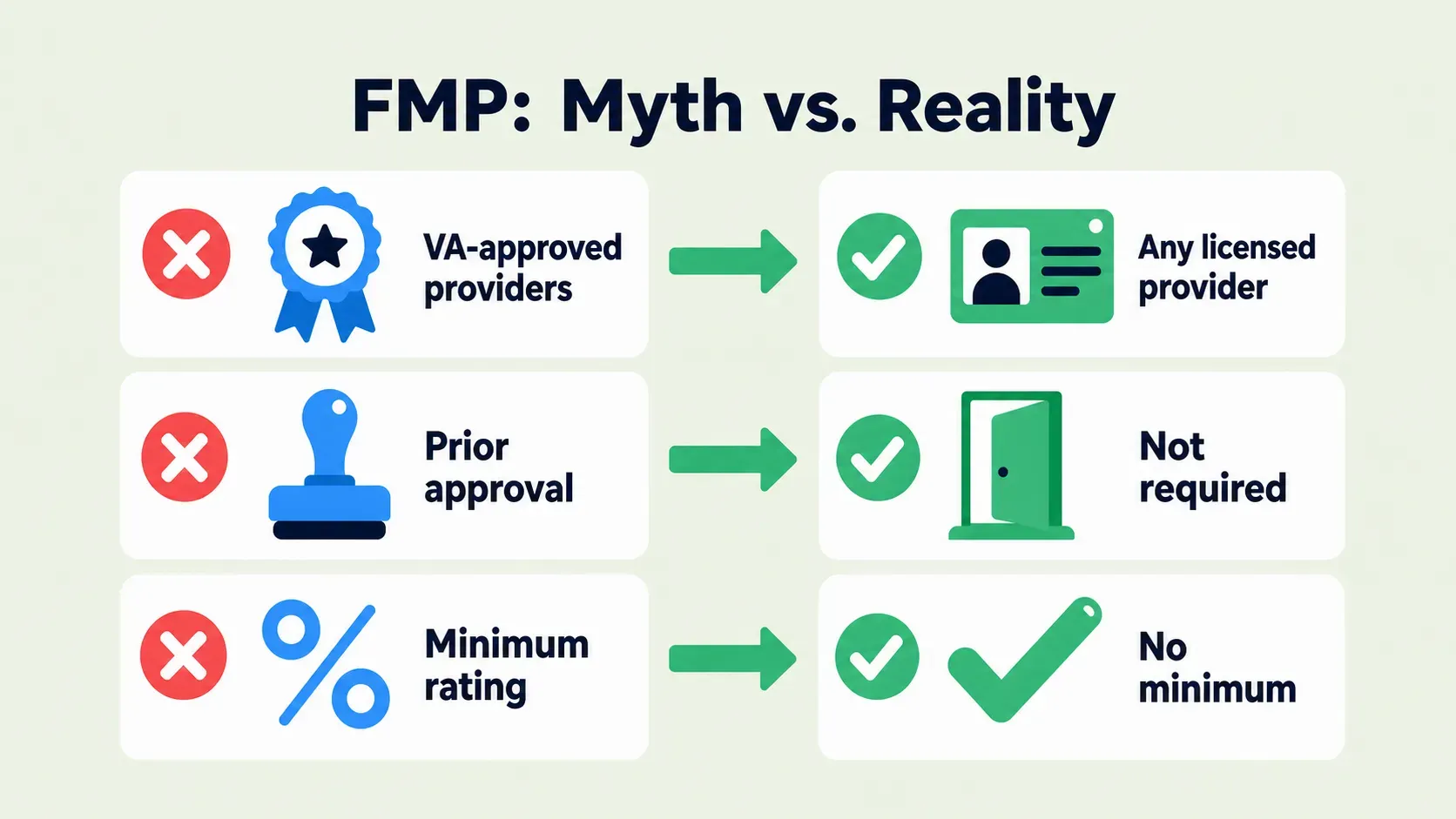
Myth: FMP Has Certified or Approved Providers
You may have heard that certain clinics are “VA-certified,” “FMP-approved,” or preferred FMP providers.
What the VA says: VA Fact Sheet 04-20 says, “FMP does not have contract providers.” Current VA guidance on getting care through FMP says you may choose any licensed health care provider in the foreign country where you live or travel.
What this means for you: VA materials do not create an “FMP-approved” or “VA-certified” provider designation. Treat those labels as marketing, not proof of FMP status. You still need a licensed provider, and VA decides whether the care itself qualifies for coverage.
Myth: You Need Pre-Authorization before Treatment
You may have heard that VA must approve treatment before you receive it.
What the VA says: The VA says you do not need a referral, an approved provider, or prior authorization for FMP care. You can use Ask VA to ask whether FMP may cover planned care, but a claim is still reviewed after submission.
Important exception: If you participate in Veteran Readiness and Employment (VR&E) and need care for a non-service-connected disability, the VA requires a referral from your VR&E case manager before care.
What this means for you: For ordinary FMP care related to a covered condition, pre-authorization is not a gate. If coverage is unclear, ask VA before committing to an expensive service.
Myth: FMP Only Covers Certain Countries
You may have heard that Colombia is outside the program.
What the VA says: FMP is for eligible care received in a foreign country. The VA excludes care received in the United States, its territories, the District of Columbia, or Puerto Rico. It also excludes care in a country that does not accept U.S. Treasury checks or does not allow travel by U.S. citizens, and care from a provider or facility barred from FMP.
What this means for you: Eligible FMP care can be covered in Colombia. Country location alone does not make a claim payable; the condition, medical necessity, service, documentation, and provider status still matter.
Myth: You Need a Minimum Disability Rating
You may have heard that you need a 30%, 50%, or other minimum rating.
What the VA says: 38 CFR § 17.35 ties FMP care to treatment of a service-connected disability, a condition associated with and aggravating one, or qualifying VR&E care. It states no minimum percentage. A 2025 U.S. Government Accountability Office report likewise says disability percentages have no bearing on FMP eligibility.
What this means for you: A lower percentage does not disqualify you by itself. The VA still decides whether each claimed service is medically necessary and connected to a covered condition.
Myth: You Must Always Pay out of Pocket First
You may have heard that every veteran must pay first and wait for reimbursement.
What the VA says: On the current FMP claims page, the VA says it pays the provider directly when the provider files the claim. If the provider does not file, you pay and submit your own reimbursement claim.
For approved claims, the VA currently uses direct deposit when it has a U.S. bank account on file. Its direct-deposit instructions tell people seeking deposit to an international account to contact Ask VA.
What this means for you: Ask the provider whether they will file, and agree on payment expectations before care. Keep your itemized bill, medical documentation, and proof of payment when applicable. Delays remain possible: the GAO reported that FMP processed 37% of claims within its 45-day target in fiscal year 2024.
Myth: FMP Is the Same as TRICARE Overseas
You may have heard that FMP and TRICARE Overseas are interchangeable.
What the agencies say: The VA fact sheet says, “There is no relationship to CHAMPUS/TRICARE.” They are separate programs with different eligibility and care rules.
| FMP | TRICARE Overseas programs | |
|---|---|---|
| Administered by | VA | Department of Defense; International SOS is the overseas contractor |
| Eligibility | Covered care abroad tied to a VA-rated service-connected condition, an aggravating condition, or qualifying VR&E care | TRICARE eligibility plus the rules of the person’s specific plan |
| Providers | Any licensed foreign provider, subject to FMP exclusions | TRICARE-authorized providers; networks and directories apply |
| Before care | No prior authorization for ordinary covered FMP care; VR&E exception noted above | Referrals or pre-authorization depend on plan and service |
| Patient cost | VA pays an approved provider claim or reimburses the veteran | Deductibles, copayments, and cost-shares vary by plan and status |
A person may qualify for both programs, but one program’s rules do not replace the other’s. Check your specific TRICARE overseas plan before receiving care.
What to Watch For
- Provider labels. “VA-certified” is not an FMP provider designation.
- Promises that a claim is guaranteed. The VA reviews whether submitted care meets FMP coverage rules.
- Missing records. Keep copies of bills, clinical records, and payment receipts.
- Old payment instructions. Use the current VA claims page rather than relying on a planned system-change date.
Sources
- VA Foreign Medical Program: current eligibility and program overview
- Getting Care Through the Foreign Medical Program: provider choice, exclusions, authorization, and VR&E exception
- VA Fact Sheet 04-20: no contract providers and no relationship to TRICARE
- File a VA Foreign Medical Program Claim: direct provider billing, veteran reimbursement, documents, and payment methods
- Direct Deposit for Your VA Payments: U.S. and international account instructions
- 38 CFR § 17.35: federal FMP eligibility rule
- GAO-25-107149: Actions Needed to Improve the Foreign Medical Program: rating percentages and fiscal year 2024 claims performance
- TRICARE Select Overseas and TRICARE Overseas region: plan rules and overseas administration