How TBI Affects Your Balance and What PT Can Do
This post was reviewed and updated on .
Dizziness and unsteadiness after a traumatic brain injury (TBI) are real symptoms with many possible, often overlapping causes. TBI can affect the inner ear, vision, sensation, or the brain pathways that combine those signals. Because different causes need different treatment, the first step is finding out what is driving your symptoms.
What TBI Does to Your Balance System
Your balance depends on three main sources of information: your inner ear (the vestibular system), your vision, and position signals from your muscles and joints. Your brain combines those inputs to keep you steady and your vision clear while you move.
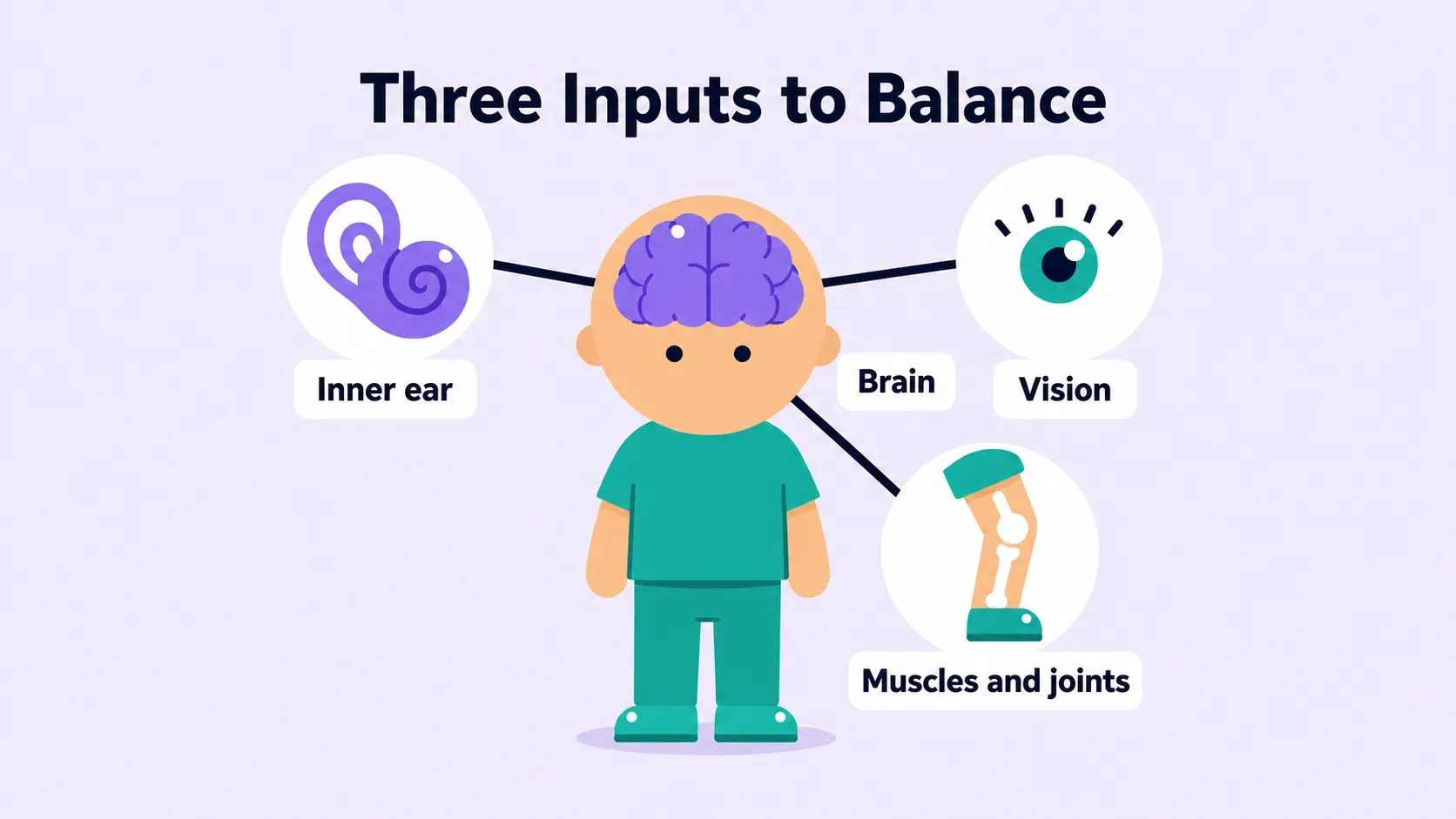
A TBI can disrupt one or more parts of that system. One possible cause is benign paroxysmal positional vertigo (BPPV). Head trauma can move tiny calcium crystals from their usual location into an inner-ear canal. This typically causes brief spinning with movements such as rolling in bed, looking up, or bending down.
BPPV is not the only explanation. Dizziness after TBI may also involve migraine, blood-pressure changes, neck problems, eye-movement difficulties, medication effects, or injury to the brain’s balance pathways. The Department of Defense’s 2026 clinical recommendation therefore uses a step-by-step assessment rather than treating every patient the same way.
Blast exposure may affect vestibular pathways, but the evidence does not support assuming one specific injury pattern or treatment. A 2022 study of 77 veterans with chronic dizziness after mild TBI and/or blast exposure found several kinds of vestibular and balance abnormalities. Because the exposure groups overlapped, the study could not isolate the effect of blast alone.
Why It Matters
Many people improve in the days or weeks after a mild TBI, but dizziness or imbalance can persist. Symptoms may be harder to manage when they occur alongside headache or migraine, hearing or vision changes, sleep problems, pain, or PTSD. These overlapping symptoms do not make the dizziness less real; they make a complete assessment more important.
Persistent dizziness is a symptom, not a diagnosis. Knowing whether the main problem is BPPV, vestibular weakness, visual-motion sensitivity, blood-pressure changes, or something else helps the care team choose the right treatment or referral.
What Physical Therapy Does
A vestibular physical therapist may check eye movements, balance, walking, neck motion, and how symptoms change with head or body position. Findings guide treatment, which may include:
- Canalith repositioning for BPPV. A trained clinician uses a sequence of head and body positions to move the displaced crystals. Some people need repeat treatment or reassessment.
- Gaze-stability exercises. These practice keeping a target clear while the head moves. The dose depends on the diagnosis and your response.
- Habituation. Carefully repeated exposure to a specific symptom-triggering movement may reduce sensitivity over time.
- Balance and walking practice. Tasks become more challenging as safety and control improve.
The evidence is encouraging but limited. A 2024 meta-analysis of six randomized trials found that vestibular rehabilitation reduced self-reported dizziness at the end of treatment after mild TBI. It did not find a lasting dizziness difference at two-month follow-up or a clear pooled improvement on one balance test. This supports an individualized trial of treatment, not a promise of a cure.
The 2021 VA/DoD guideline similarly suggests a short-term trial of specific vestibular and proprioceptive exercises for persistent dizziness or imbalance after mild TBI. If symptoms do not improve despite following the plan, the guideline advises reassessing rather than continuing an ineffective course indefinitely.
What You Can Expect
There is no reliable one-size-fits-all recovery timeline after TBI. Your plan should match the suspected cause, injury severity, other health conditions, goals, and response to treatment. A clinician can track symptoms and function, adjust the exercises, and refer you for hearing, vision, neurological, or medical evaluation when needed.
Home practice often supports supervised care, but generic exercise doses are not appropriate for every diagnosis. Ask which exercises to do, how often to do them, what symptom increase is acceptable, and when to stop and report a change.
When to Seek Help
Ask for a clinical evaluation if dizziness or imbalance persists, worsens, limits daily activity, or causes falls or near-falls. Sudden or rapidly worsening hearing loss, especially in one ear, needs urgent medical assessment. Fainting or symptoms triggered by standing also deserve medical review.
Seek emergency care immediately after a head injury for a worsening headache, repeated vomiting, seizure, increasing confusion, unusual drowsiness or inability to wake, slurred speech, weakness or numbness, decreased coordination, or one pupil larger than the other. Sudden trouble seeing, speaking, walking, or maintaining balance can also be a sign of stroke and needs emergency care.
Sources
- VA/DoD Clinical Practice Guideline for the Management and Rehabilitation of Post-Acute Mild Traumatic Brain Injury, Version 3.0, 2021
- Assessment and Management of Dizziness and Visual Disturbances Following Concussion/Mild TBI, DoD TBI Center of Excellence, January 2026
- The efficacy of vestibular rehabilitation therapy for mild traumatic brain injury: a systematic review and meta-analysis, Journal of Head Trauma Rehabilitation, 2024
- Vestibular and balance function in veterans with chronic dizziness associated with mild TBI and blast exposure, Frontiers in Neurology, 2022
- Symptoms associated with vestibular impairment in veterans with posttraumatic stress disorder, PLOS ONE, 2016
- Symptoms of mild TBI and concussion, CDC
- Signs and symptoms of stroke, CDC