Shoulder Impingement: What the Research Says Actually Helps
If you were told you have shoulder impingement, you are in large company. A study in the Journal of Shoulder and Elbow Surgery (2015) counted almost 107,000 cases among U.S. active-duty service members over 10 years, and the rate rose with age. Research on what helps has become much clearer, and most of it points to exercise.
What Is Rotator Cuff-Related Shoulder Pain
Your rotator cuff is a group of 4 muscles that start on your shoulder blade. Their tendons (the tough cords that attach muscle to bone) wrap around the ball at the top of your upper arm bone and keep it centered while you lift and reach.
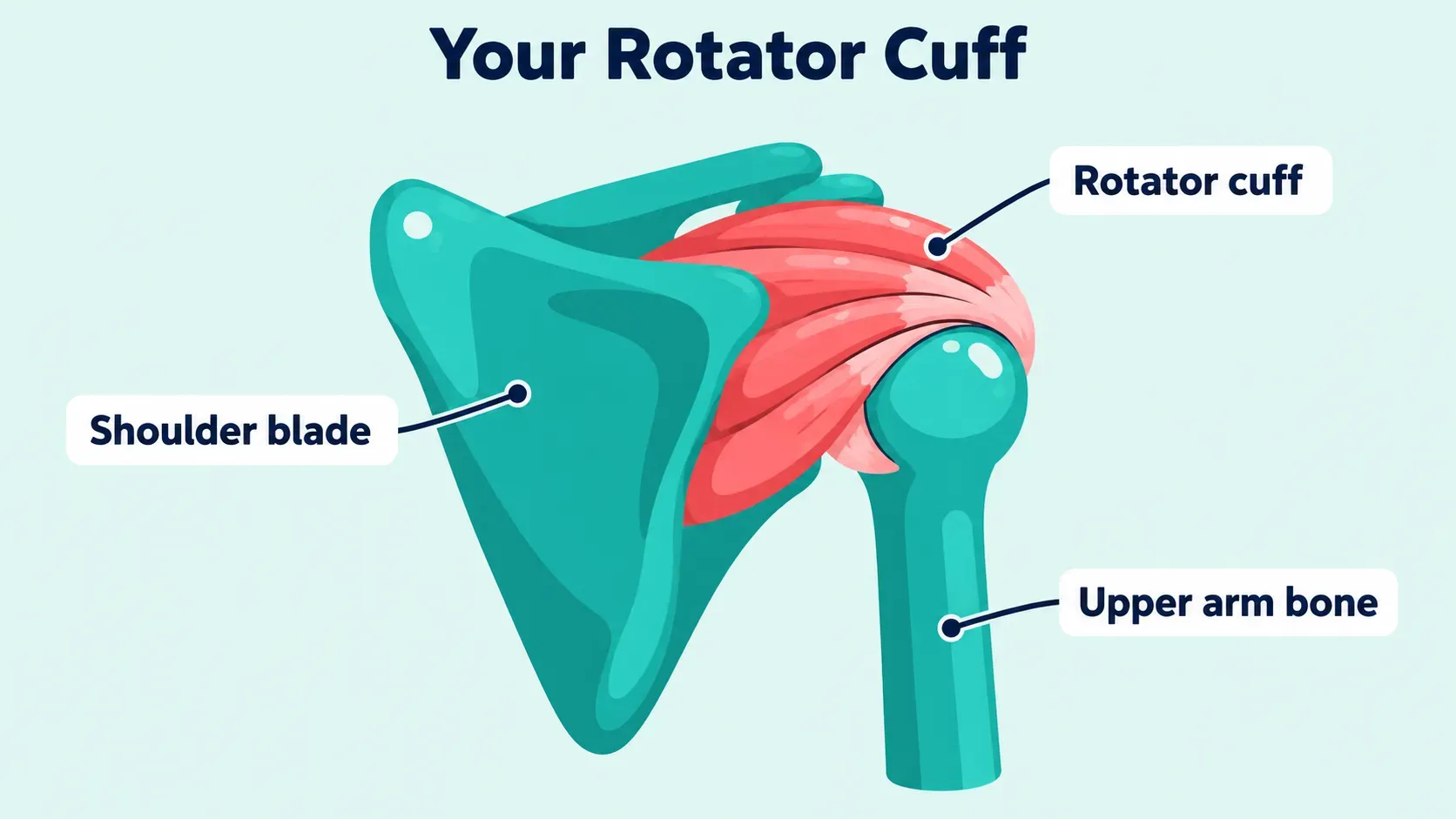
The old explanation was that a bone at the top of the shoulder pinches the tendon when you raise your arm, so surgeons shaved that bone. Then trials compared that surgery with placebo surgery: a camera look inside the joint with no bone removed. Patients did not know which they got. Both groups did about the same.
Because the “pinching” idea did not hold up, clinicians in a global survey chose rotator cuff-related shoulder pain as the preferred term, a 2025 commentary in the Journal of Orthopaedic & Sports Physical Therapy (JOSPT) reported. It is the same pain.
The current view is that the tendon becomes irritated when the load on it is more than it is ready for. Posture and shoulder blade movement may contribute, but studies disagree on how much.
Scans can mislead. A review of 30 studies in the Journal of Shoulder and Elbow Surgery (2014) found rotator cuff changes on imaging in about 1 in 10 people age 20 or younger and in 62% of people 80 or older, rising similarly with or without shoulder pain. A “tear” on your MRI report does not, by itself, explain your pain.
How It Affects Your Daily Life
The pain usually sits on the front or outside of the shoulder and upper arm. It often flares when you lift your arm overhead, reach behind your back, put on a jacket, or lie on that side at night. In the VA’s Annual Benefits Report for fiscal year 2025, limitation of motion of the arm was the 7th most common service-connected disability, with about 1.39 million ratings.
A study of 389 physical therapy patients in Physical Therapy (2017) linked anxiety and depression to a lower chance of recovery. If you live with either, address them together.
What Physical Therapy Does
The 2025 JOSPT clinical practice guideline on rotator cuff tendinopathy, endorsed by the American Physical Therapy Association, gives its strongest grade to exercise as the first treatment and advises against routine imaging at the start. Therapy usually includes:
- Strengthening the rotator cuff. Rotation exercises with a band or weight, made harder as your shoulder tolerates more. No single style (slow lowering, lifting, or holding) has proven better.
- Strengthening the muscles around your shoulder blade. A common part of a full program, though not proven better than general shoulder strengthening.
- Learning to adjust your load. The guideline recommends education about your condition and activity changes. We help you keep what your shoulder tolerates and scale back what flares it, rather than resting it completely.
- Hands-on treatment. The guideline says manual therapy may give short-term pain relief, alongside exercise, not in place of it.
In a 2012 trial in the BMJ, 102 patients on a surgical waiting list did 12 weeks of specific shoulder exercises or general exercises. Afterward, 20% of the specific-exercise group chose surgery, compared with 63% of the others. At 10 years, the gap remained: 35% compared with 65%.
What About Injections and Surgery?
The JOSPT guideline says a steroid injection can reduce pain for up to 8 weeks, but not as the first treatment. A trial at Madigan Army Medical Center, in the Annals of Internal Medicine (2014), compared an injection with 6 sessions of manual physical therapy in 104 patients. Both groups improved by about half at 1 year, but the injection group made more shoulder-related primary care visits (60% compared with 37%).
The CSAW trial (The Lancet, 2018, 313 patients) and the FIMPACT trial (BMJ, 2018, 210 patients) found that shaving the bone did no better than placebo surgery. FIMPACT’s 10-year follow-up (BMJ, 2025) found no advantage over placebo surgery or exercise. A 2019 Cochrane review rated this evidence high certainty, and a BMJ guideline panel (2019) strongly recommended against this surgery for pain lasting more than 3 months that did not start with an injury.
That covers this one operation for this kind of pain. A tendon torn in a fall is a different problem, and surgical repair is sometimes the right choice.
What You Can Expect
In the Physical Therapy study, 60% of patients had recovered at 26 weeks, so about 4 in 10 had not. Shorter symptom duration and lower starting disability went with better results.
Your outlook matters too. In a study of 1,030 physiotherapy patients in the British Journal of Sports Medicine (2018), people who expected a full recovery and felt confident managing their pain did better at 6 months.
If your pain has not improved after a maximum of 12 weeks of good nonsurgical care, the JOSPT guideline says it is time to consider imaging or a specialist referral.
When to Seek Help
Call 123, Colombia’s emergency line, if shoulder or arm pain comes with chest pain, pressure, shortness of breath, or sweating. That can be a heart problem.
Get same-day medical care if:
- Your shoulder looks out of place or deformed after a fall, or you suddenly cannot move it
- The joint is hot, red, and swollen, or you have fever or chills
- You notice sudden, serious weakness or numbness in the arm
See a doctor within days if you suddenly cannot raise your arm after an injury, which can mean a torn tendon. See a doctor soon for a new lump, unexplained weight loss, or night sweats, especially with a history of cancer.
Sources
- Shoulder impingement incidence in the U.S. military, 1999 to 2008. Journal of Shoulder and Elbow Surgery, 2015
- The case for the term “rotator cuff-related shoulder pain.” Journal of Orthopaedic & Sports Physical Therapy, 2025
- Prevalence of rotator cuff abnormalities by age in people with and without symptoms, a systematic review. Journal of Shoulder and Elbow Surgery, 2014
- VBA Annual Benefits Report, fiscal year 2025, compensation section. U.S. Department of Veterans Affairs, 2025
- Prognostic model for shoulder pain in physical therapist practice. Physical Therapy, 2017
- Rotator cuff tendinopathy diagnosis, nonsurgical medical care, and rehabilitation: a clinical practice guideline. Journal of Orthopaedic & Sports Physical Therapy, 2025
- Specific exercise strategy and the need for surgery in subacromial impingement syndrome. BMJ, 2012, with 10-year follow-up in Journal of Shoulder and Elbow Surgery, 2025
- Subacromial corticosteroid injection compared with manual physical therapy, 1-year outcomes. Annals of Internal Medicine, 2014
- Arthroscopic subacromial decompression for subacromial shoulder pain (CSAW). The Lancet, 2018
- Subacromial decompression compared with diagnostic arthroscopy (FIMPACT). BMJ, 2018, with 10-year follow-up in BMJ, 2025
- Subacromial decompression surgery for rotator cuff disease. Cochrane Database of Systematic Reviews, 2019
- Subacromial decompression surgery for adults with shoulder pain: a clinical practice guideline. BMJ, 2019
- Psychological factors and the outcome of physiotherapy for shoulder pain. British Journal of Sports Medicine, 2018
- Shoulder pain assessment and red flags, based on NICE Clinical Knowledge Summaries. Patient.info Professional, 2024