Learning Spanish in Medellin as a Veteran
This post was reviewed and updated on .
Learning Spanish in Medellin affects healthcare, transportation, paperwork, friendships, and independence. You do not need perfect Spanish to live well here, but a workable foundation can make daily life safer and less isolating.
The honest version: there is no evidence-based calendar that predicts when an individual adult will feel conversationally comfortable. Progress depends on prior experience, study time, practice, health, and goals. Slow progress still counts.
The Reality
Large studies agree that age affects second-language learning, but researchers disagree about the shape and timing of that effect. A 2018 study proposed a sharper late-adolescent change in grammar learning; a 2022 reanalysis of the same data found steadier decline and important differences among learner groups. Neither finding means adults cannot learn useful Spanish.
A practical first target is functional conversation: explain symptoms, ask follow-up questions, handle errands, and talk with neighbors. That goal is clearer than “fluency,” which can mean anything from ordering lunch to working professionally.
Why Immersion Needs Structure
Living in Medellin provides constant exposure, but exposure alone does not guarantee learning. A 2024 meta-analysis covering 42 study-abroad studies and 283 effect sizes found medium-to-large overall language gains. Results varied with factors such as course design, program length, and living arrangements. Most participants were students in organized programs, not veterans settling long term in Colombia, so the study cannot set your personal timeline.
Use the useful part of that evidence: combine instruction with deliberate contact. A class or tutor can organize the language; neighbors, appointments, errands, and intercambios give you reasons to use it.
What Makes Paisa Spanish Different
Medellin Spanish will not always match a textbook. In Antioquia, vos commonly appears alongside tú and usted: vos hablás, vos comés, vos vivís. You may also hear usted between people who know each other well. Switching forms can reflect closeness, formality, or the moment.
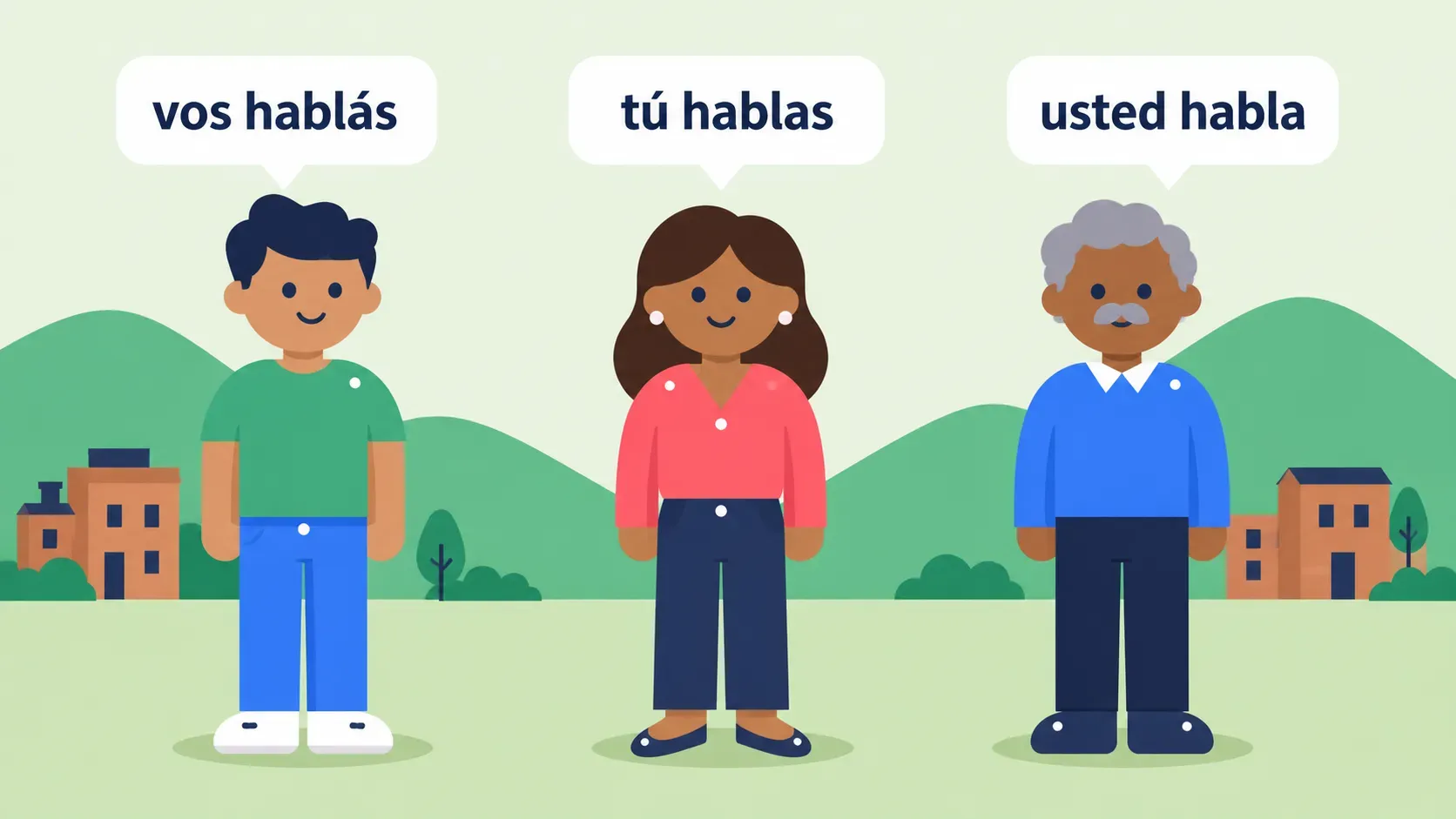
A small 2020 Medellin study (10 middle- and upper-income participants) found that relationship, age, and gender influenced use of vos, and participants associated voseo with paisa identity. That supports teaching learners to recognize voseo, but the sample is too small for claims about every paisa speaker.
You will also hear local words such as parce and expressions with pues. Listen before copying slang: meaning and tone depend on context.
If You Have TBI or Cognitive Fatigue
Attention, memory, and executive-function problems can persist after mild traumatic brain injury. The 2021 VA/DoD guideline recommends individualized assessment and, for some persistent cognitive symptoms, a short trial of clinician-directed cognitive rehabilitation. It does not identify language study as TBI treatment or prescribe 30-45-minute lessons or a fixed number of new words.
Work with your current capacity:
- Stop a study session before fatigue overwhelms it.
- Learn a small group of phrases tied to one real task.
- Combine audio, written words, pictures, and practice.
- Repeat material across days and allow extra response time.
- Keep symptoms, medications, and key questions written on your phone for appointments.
If study repeatedly worsens headaches, dizziness, sleep, or other symptoms, discuss the pattern with a qualified healthcare professional.
Healthcare Is Where Planning Matters Most
Systematic reviews found better communication and aspects of care when patients received professional interpretation or shared a language with clinicians. Most included studies involved patients with limited English in English-speaking health systems, not English-speaking veterans in Colombia, so the exact size of benefit here is unknown.
VA’s Foreign Medical Program (FMP) may cover medically necessary care outside the United States for eligible service-connected conditions and certain related care. VA’s claim guidance says it will translate claim information submitted in another language. FMP pages do not list an appointment interpreter as a program benefit. Ask the Colombian provider about professional interpretation or arrange trusted language support before a complex visit.
Where to Start in Medellin
As of August 2026, official pages confirm Spanish instruction at EAFIT and UPB. EAFIT lists personalized, in-person instruction; UPB lists group and private ESPEX classes with 2026 start dates. Formats, dates, and prices can change, so check the program page before paying. Intercambios can add conversation practice, but they do not provide the structure everyone needs at the beginning.
VA rules are clearer than the old WEAMS advice suggested: for most VA education benefits at a foreign school, the approved program must lead to a standard associate degree or higher. VA states that stand-alone language programs, diplomas, and certifications cannot be approved. Use the GI Bill Comparison Tool to check the exact degree program, not only the institution name.
Tips from Experience
- Choose one first goal: appointments, taxis, restaurants, or neighbor conversations.
- Say, “Estoy aprendiendo. Por favor, hábleme despacio.”
- Practice a short script before a pharmacy, clinic, or front-desk conversation.
- Ask people to repeat or write down important details.
- Let your accent exist. Being understood matters more than sounding native.
- If fluency is not your goal, prioritize emergency and medical phrases plus reliable language support.
Learning Spanish is one way to build a life in Medellin. Some veterans become fluent; others use key phrases and planned support. Both paths can work. Be honest about gaps, reduce risk where communication matters, and give yourself time.
Resources
- EAFIT Spanish program
- UPB ESPEX Spanish program
- VA foreign-program education rules
- VA GI Bill Comparison Tool
- VA Foreign Medical Program claim guidance
Sources
- Hartshorne, Tenenbaum, and Pinker, Cognition, 2018, and Van der Slik et al., Language Learning, 2022 (competing analyses of age effects in second-language learning): https://doi.org/10.1016/j.cognition.2018.04.007 and https://doi.org/10.1111/lang.12470
- Tseng et al., Language Teaching Research, 2024 (multilevel meta-analysis of study-abroad language programs): https://doi.org/10.1177/1362168820988423
- Fernández Acosta, Dialectologia, 2020 (Medellin voseo study and sample details): https://dialnet.unirioja.es/servlet/articulo?codigo=7431327
- VA/DoD, 2021 (clinical practice guideline for post-acute mild traumatic brain injury): https://www.healthquality.va.gov/guidelines/rehab/mtbi/
- Flores, Medical Care Research and Review, 2005, and Diamond et al., Journal of General Internal Medicine, 2019 (systematic reviews of professional interpretation and patient-clinician language concordance): https://pubmed.ncbi.nlm.nih.gov/15894705/ and https://pubmed.ncbi.nlm.nih.gov/31147980/