Breathing Exercises for Pain Relief
This post was reviewed and updated on .
Slow diaphragmatic breathing may help some people manage pain, but it is not a cure and there is no single proven pace that works for everyone. This guide offers one flexible way to practice, plus options if counting or body focus feels uncomfortable.
Before You Begin
- Breath focus can increase distress for some trauma survivors. VA guidance notes that relaxation can initially feel worse for a few people when it draws attention to upsetting body sensations. You may stop, keep your eyes open, or choose an external grounding exercise instead.
- Breath holds are optional. Box breathing and 4-7-8 breathing include holds, but neither has good evidence for pain relief. Skip holds if they cause air hunger, dizziness, anxiety, or trauma reminders.
- Breathing is one tool, not a treatment for PTSD or a replacement for pain care. The 2023 VA/DoD guideline recommends established trauma-focused therapies for PTSD and finds insufficient evidence for relaxation training as a PTSD treatment.
What the Evidence Shows
Results are promising but depend on the condition and program. A 2022 review of seven randomized trials found that slow deep breathing may reduce acute burn, labor, or postoperative pain, but results varied greatly and the evidence was rated very low certainty. A 2025 review found low- to very-low-certainty benefits for spinal pain when breathing was added to other care.
For nonspecific low back pain, a 2026 review of 13 randomized trials involving 626 people found moderate-certainty evidence that diaphragmatic training can reduce pain and disability. These findings support breathing as an option within rehabilitation, not as a guaranteed stand-alone solution.
A Gentle Diaphragmatic Breathing Practice
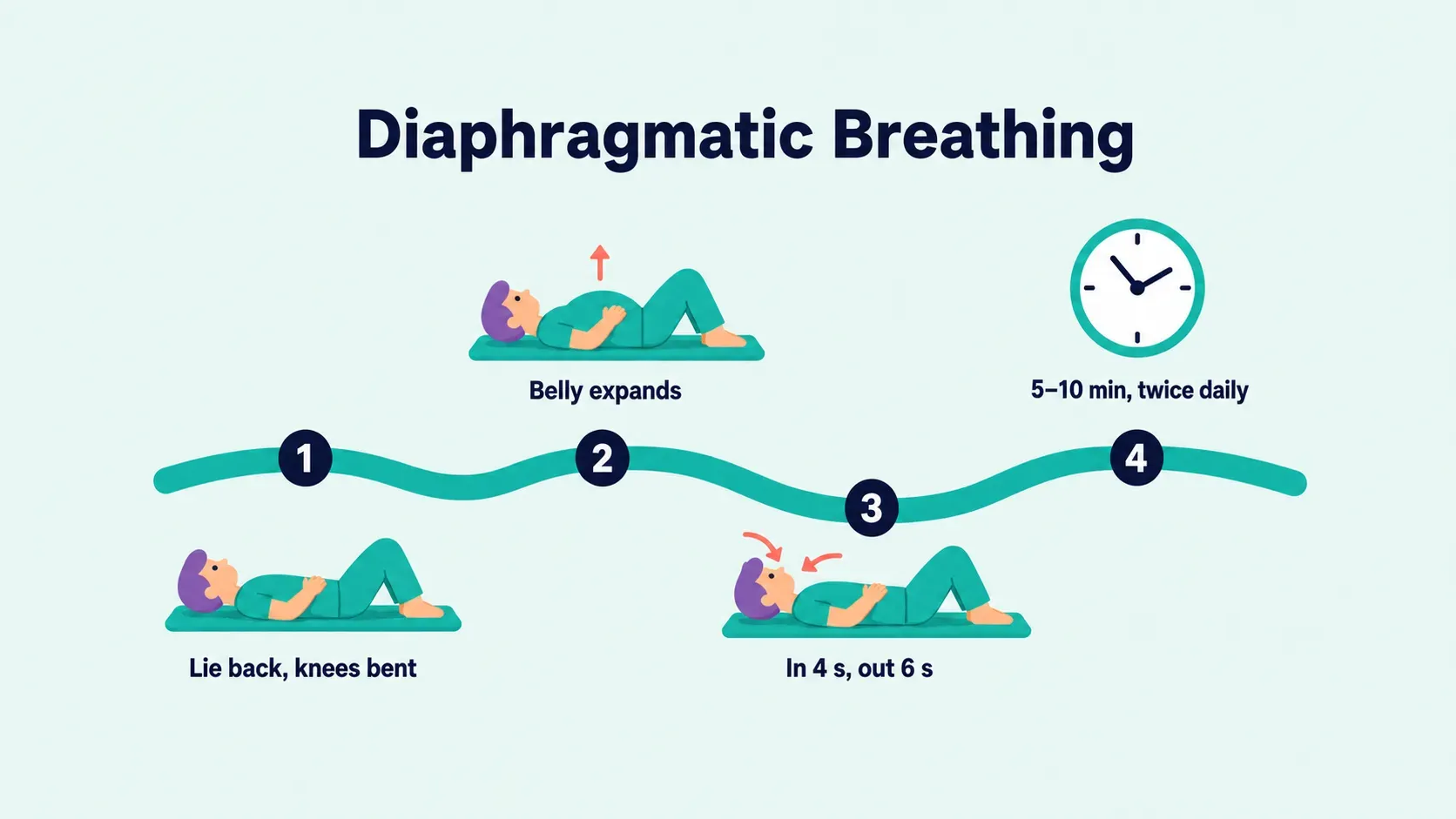
Step 1: Choose a Comfortable Position
Lie on your back with your knees bent or sit in a supported chair. If useful, place one hand on your upper chest and one below your ribs. Keep your eyes open if that feels better.
Step 2: Let the Abdomen Move
Inhale gently through your nose. Allow the lower ribs and abdomen to expand without forcing a large breath. Your chest will move some; the goal is less tension in your shoulders, not a perfectly still chest.
Step 3: Try a Comfortable Pace
One option is:
- Inhale for 4 seconds
- Exhale for 6 seconds through your nose or gently parted lips
- Do not hold your breath
This equals about six breaths per minute, a rate used in some studies. It is not a proven ideal pain-relief rate. If counting feels restrictive or you become short of breath, return to normal breathing or use a shorter count. A comfortable longer exhale is an option, not a required “active ingredient.”
Step 4: Practice Briefly and Reassess
The VA Whole Health pain handout suggests 5-10 minutes, twice daily, in a comfortable position. Treat that as a practice schedule, not a promise of results. Research programs use varied schedules, and no exact dose or timeline has been established for lasting pain relief.
Two Flexible Variations
Pursed-lip exhale. Inhale gently through your nose, then exhale through loosely pursed lips. This technique is established for some people with COPD and can lengthen the exhale without counting, but its pain-specific benefit is uncertain.
External grounding. Let your breathing continue naturally while you name visible objects, notice sounds in the room, or feel your feet against the floor. VA and SAMHSA grounding guidance uses present surroundings to reduce internal focus.
Pair Breathing with Movement
Breathing can be used as a movement cue. For routine lifting, pushing, standing, or climbing stairs, try exhaling during the effort instead of holding your breath for a long time. Near-maximal lifting is different: the Valsalva maneuver may increase trunk pressure and blood pressure, so technique should be individualized if you have cardiovascular or pelvic-floor concerns.
For low back pain, diaphragmatic training may help when included in rehabilitation. It has not been shown to replace general exercise or to guarantee correct activation of deep abdominal or pelvic-floor muscles.
What to Watch For
- Lightheadedness or tingling: You may be over-breathing. Stop and return to normal breathing. Seek assessment if symptoms are new, severe, or persistent.
- Shoulder or jaw tension: Make the breath smaller and easier rather than deeper.
- Panic, a flashback, or feeling detached: Stop. Look around, press your feet into the floor, and name a few things you see. Discuss repeated reactions with a mental health professional.
- More pain: Do not push through a breathing practice that consistently worsens symptoms.
When to Get Help
Seek emergency help now for severe or new chest pain, severe or unexplained shortness of breath, or sudden neurologic signs such as facial droop, weakness, trouble speaking, or vision changes.
For nonemergency concerns, talk with your physician or physical therapist if breathing practice repeatedly worsens pain, causes distress, or is not helping. A trained clinician can assess breathing mechanics; suspected diaphragm weakness may require pulmonary-function testing or imaging.
Sources
- Slow deep breathing for acute clinical pain: systematic review and meta-analysis of 7 randomized trials, Journal of Evidence-Based Integrative Medicine, 2022
- Breathing interventions for spinal pain: systematic review and meta-analysis of 20 studies, Clinical Rehabilitation, 2025
- Diaphragmatic training for nonspecific low back pain: systematic review and meta-analysis of 13 randomized trials, Archives of Physical Medicine and Rehabilitation, 2026
- The Power of Breath: Diaphragmatic Breathing, VA Whole Health Library
- Self-Management of Chronic Pain, VA Whole Health Library
- VA/DoD Clinical Practice Guideline for PTSD and Acute Stress Disorder, 2023
- Coping with Traumatic Stress Reactions, VA National Center for PTSD
- Grounding Techniques from TIP 57, SAMHSA/NCBI Bookshelf